Commodore's Cut
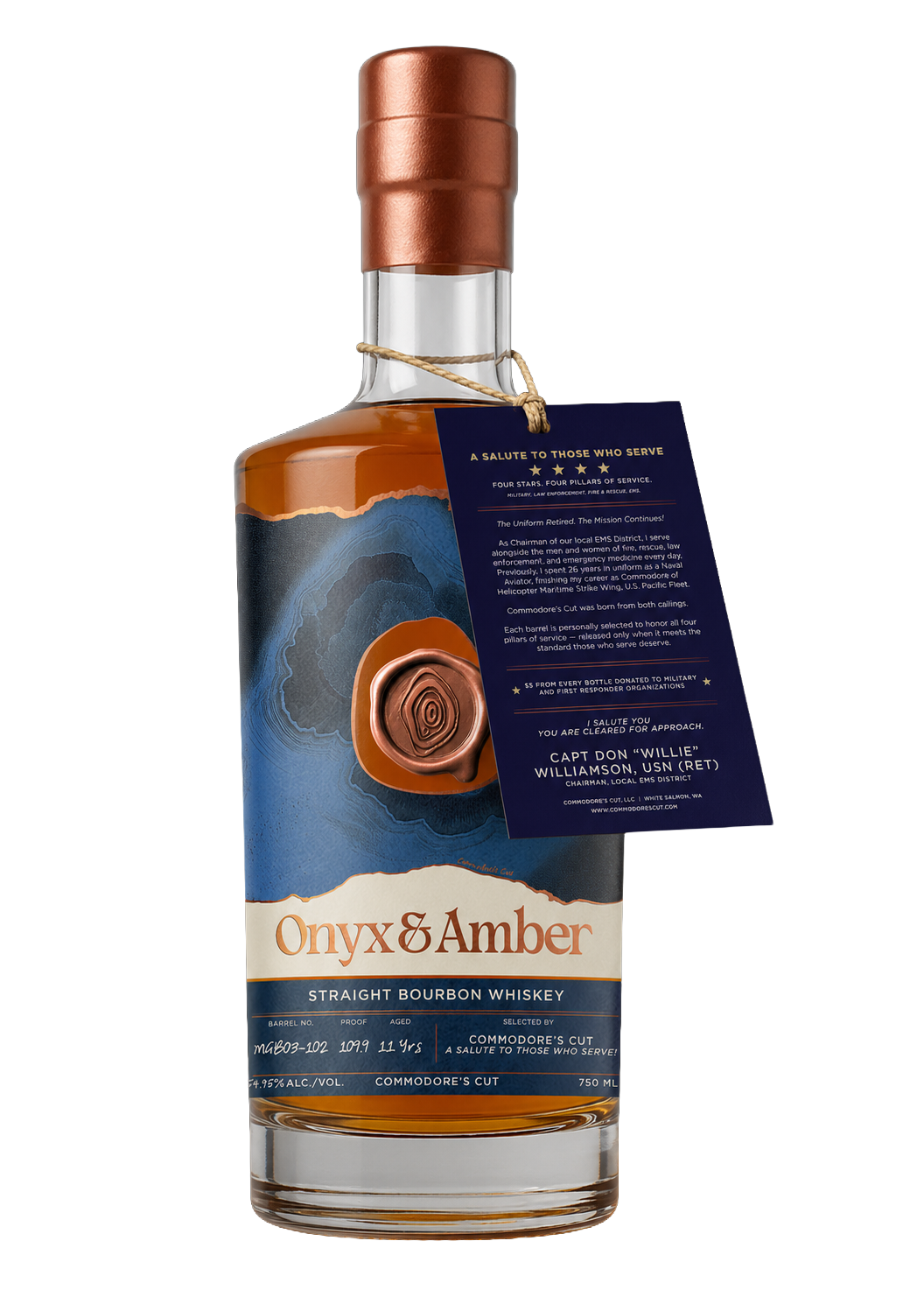
Cut No. 1 Single Barrel Straight Bourbon Whiskey
Barrel No. 2192 | Ross & Squibb, Indiana | Aged 11+ Years | 109.9 Proof
Release Date: May 12, 2026
Product Details | Barrel Specs
DISTILLERY
Ross & Squibb (MGP Ingredients), Lawrenceburg, Indiana — Est. 1847
AGE
11+ Years
PROOF
109.9 (Barrel Strength, Uncut — not cut or filtered)
BARREL NO.
2192 (MGP internal: MGB03-102)
BOTTLES
~150 — Single Barrel, Limited Release
MASH BILL
60% Corn, 36% Rye, 4% Barley
SELECTED BY
CAPT Don "Willie" Williamson, USN (Ret.) — Founder, Commodore's Cut
NOSE
Deep and inviting from the first approach. Brown sugar leads with warmth and sweetness, quickly joined by the crisp, aromatic lift of baking spice — a natural expression of the rye-forward mash bill at work. The color commands attention before the first sip is taken — a deep, dark mahogany that is remarkable for an eleven-year bourbon and speaks directly to the extraordinary influence of Canton Cooperage's air-seasoned oak. Nose the glass slowly. There is a lot here.
PALATE
The entry is sweet and immediate — brown sugar and caramel arriving together across the front of the palate. As the pour moves through the mid-palate, the rye spice asserts itself with confidence, creating a balance with the sweetness that feels effortless rather than engineered. At 60% corn, 36% rye, and 4% malted barley, this MGP mash bill delivers complexity in waves. Nothing announces itself all at once. This is a bourbon that rewards patience and a slow sip.
MOUTH-FEEL
Full and generous from the first sip. The viscosity is immediately apparent — a weight and richness that coats the palate and signals the influence of eleven years in well-seasoned Canton oak. Despite the 109.9 proof, there is no harsh heat or sharp edges. The pour is silky and unhurried, moving across the palate with a smoothness that belies its strength. This is a high-proof bourbon that drinks well above its weight class.
FINISH
Longer and gentler than the 109.9 proof would suggest — and that is precisely the point. The finish is warm, smooth, and unhurried, with a viscous weight that lingers without heat. Approachable enough for the first-time bourbon drinker. Deep enough for the most serious collector. The Canton oak makes its final statement here — quietly, and with authority.
COMPLEXITY
Barrel 2192 does not reveal itself all at once — and that is its greatest virtue. The nose, palate, and finish each tell a different part of the same story, and that story changes with every sip as the pour opens up in the glass. The interplay between the corn sweetness, rye spice, and deep oak character creates layers that reward attention. This is not a one-note bourbon. It is a conversation that deepens the longer you stay with it.
OVERALL
Barrel 2192 earned the right to be Cut No. 1. It announces itself visually before you ever raise the glass — a deep, dark pour that carries the weight of eleven years in well-seasoned wood and stops you before the first sip. What follows delivers on that promise completely: simultaneously rich and approachable, bold and balanced, complex and generous. The only regret is that 154 bottles is all there will ever be. That is the pleasure and the burden of a single barrel — once it is gone, it is gone. What remains is the memory of a pour that was worth the wait.
Tasting Notes
Every barrel in the Commodore's Cut program is selected by hand. Not by algorithm, not by committee — by a Naval Aviator who spent 26 years making high-stakes decisions under pressure. Barrel 2192 was chosen because three things came together in a single vessel: the craft of a 175-year-old Indiana distillery, the precision of a French coopering tradition applied to Kentucky white oak, and aging at a mile above sea level. Here is what that means.
THE DISTILLERY: ROSS & SQUIBB, EST. 1847
The spirit in this barrel was distilled at the Ross & Squibb Distillery in Lawrenceburg, Indiana — one of the oldest continuously operating distilleries in the United States. The facility was founded in 1847, predating the Civil War, and sits less than ten miles from the Kentucky border, drawing from an underground aquifer of limestone-filtered water that has shaped its character for nearly 180 years.
Under various owners across its long history — including the Seagram's empire at its peak — the Lawrenceburg distillery earned a reputation as one of the premier producers of American whiskey. Today, operating as Ross & Squibb under MGP Ingredients, it continues that tradition. The distillate in Barrel 2192 reflects that heritage: a high-quality Indiana straight bourbon, distilled with the precision and consistency that has made this facility a quiet pillar of American whiskey for generations.
It is, in the truest sense, proven juice from proven stills.
The Story Behind This barrel
the Distillery -
Ross & Squibb, Est. 1847
The Story Behind This barrel
the Barrel - Canton Cooperage
Most bourbon barrels are built from kiln-dried staves — wood that is force-dried in a matter of days to meet production schedules. Barrel 2192 was different from the moment it was built.
Canton Cooperage, located in Lebanon, Kentucky, operates according to French coopering tradition — a method that prioritizes patience over speed. Every stave in a Canton barrel is individually evaluated for grain and straightness, then stacked in Canton's Kentucky wood yard and left to season naturally in the open air. The staves for Barrel 2192 dried for 24 months before a single hoop was set.
That time matters. Natural air seasoning allows the successive cycles of Kentucky seasons — heat, cold, rain, drought — to slowly draw out the harsh compounds in the wood. What remains after two years in the yard is oak that is softer, more aromatic, and more complex in the flavors it will give to the spirit. The result is a barrel that works with the spirit rather than against it — contributing layers of vanilla, caramel, and dried fruit across eleven years without the rough edges that lesser wood can leave behind.
Canton Cooperage is a member of the Chêne Group, which includes Taransaud — one of the most respected French cooperages in the world. Buffalo Trace, among the most decorated distilleries in American whiskey, has used Canton barrels for premium expressions. The Commodore selected a barrel from the same cooperage.
"Not all barrels are built equal. Two years of open air and Kentucky seasons separate a Canton stave from what most distilleries use. That difference lives in every glass."
— CAPT Don "Willie" Williamson, USN (Ret.) | Founder, Commodore's Cut
The Story Behind This barrel
the Environment -
Aged at A Mile High
Denver, Colorado sits at a mile above sea level. That elevation is not just scenery — it is an active participant in how bourbon ages.
At altitude, atmospheric pressure is lower. That means the air is drier, temperature swings between seasons are more pronounced, and the dynamics of evaporation through the barrel stave change. Water leaves the barrel more readily than alcohol in a dry, high-altitude environment — which is why Colorado-aged bourbons often show rising proof over time. Barrel 2192's 109.9 proof at bottling is consistent with exactly this pattern: the barrel gained proof as it aged, a signature of high-altitude conditions.
Colorado distillers who have studied this directly report that bourbon matures faster at elevation, and that certain flavor characteristics — particularly butterscotch, dried fruit, and a distinctive dryness in the finish — develop more readily in the Colorado environment than at sea level. These are not shortcuts or artificial interventions. They are the natural consequence of physics and climate acting on wood and spirit across more than a decade.
What you taste in Barrel 2192 was shaped by three environments in sequence: the Indiana distillery where it was born, the Kentucky wood yard where its staves seasoned for two years before the barrel was even built, and the Colorado air that surrounded it as it aged. Each one left its mark.
The Story Behind This barrel
the Selection
The Commodore did not set out to find the most expensive barrel, or the one with the most impressive resume. He set out to find the one that was ready — the same standard he applied for 26 years when determining whether a mission, a crew, or an aircraft was ready to launch.
Barrel 2192 was ready. Eleven years in the making, built on two years of patient wood seasoning, distilled in a facility that has been producing exceptional American whiskey since 1847. The proof is 109.9 — barrel strength, uncut, exactly as it came from the wood. Nothing added. Nothing removed.
The Commodore selects. The rest is yours to discover.
How to Purchase
at Onyx & Amber
Commodore’s Cut is selected from aged single barrel inventory, bottled, and fulfilled in collaboration with Onyx & Amber. When you click below, you will be taken to the Commodore’s Cut purchase page on the Onyx & Amber website. All orders, fulfillment, and shipping are handled by O&A, with direct-to-consumer delivery available in 45 states.
Onyx & Amber was chosen because their standards and mine align — in barrel selection, in transparency about provenance, and in the belief that exceptional whiskey should be able to tell you exactly where it came from and why it was chosen.
ABOUT ONYX & AMBER
Commodore's Cut is produced in collaboration with Onyx & Amber, Denver, Colorado — a craft spirits company founded by the Colorado Bourbon & Rye Collectors community. Onyx & Amber ages sourced whiskey at altitude in Denver's unique climate, where barometric pressure swings and dry mountain air accelerate maturation and concentrate flavor.
Learn more about Ben Rosen and Onyx & Amber: www.onyxandamber.com